If you’ve ever found yourself standing in just the right corner of your home or building, trying to coax one more bar of WiFi signal, you’ll know the feeling.
Dropped connections during video calls. Missing the 3 most important words of a sentence mid-call. Streaming that buffers at the worst possible moment. A garage, pool house or guest suite where the signal simply fades away.
These aren’t unusual scenarios. In fact, they’ve become surprisingly common in modern homes and larger buildings - even when the internet service itself is perfectly adequate.
In most cases, the issue isn’t speed. It’s distribution.
Perfectly good WiFi, stretched beyond what it was ever designed to cover.
It comes down to coverage and intent. And it’s something we see every week.
The upside? With the right design approach, it’s entirely solvable.
A router brings the internet into your home or building, and once inside, sends the internet to everything connected inside your space.
Understanding this function is important, because one of the most common assumptions we hear is that upgrading to a newer or more powerful router will solve everything.
Sometimes it helps. More often than not, it doesn’t - because the issue is the space itself.
WiFi signals weaken the further they travel, and they struggle to pass through obstacles like concrete, brick, steel, glass and multiple floors. No matter how advanced the hardware, those physical realities still apply.
A simple way to think about it is sunlight. Sit in direct sun and you feel its full intensity. Move under a tree and it softens, but it’s still there. Head downstairs into a garage and the light disappears entirely. WiFi behaves much the same way.
Even the best router can’t bend the laws of physics.
Which leads many clients to an important realisation.
Homes and buildings today are larger, more complex and constructed with denser materials than ever before. More rooms. More walls. More floors. More separation between spaces.
They’re also far more connected than they were even a decade ago.
Multiple levels, concrete slabs, external entertaining areas, garages, basements, separate living spaces, dedicated home offices, gyms and guest accommodation are now the norm - not the exception.
Add dozens of connected devices and constant streaming, and a single router quickly becomes overwhelmed.
The result is familiar: dead zones, dropouts and frustration - often in the very spaces where reliable WiFi matters most.
More WiFi Access Points (WAPs) solve this problem, seamlessly.
If any of the following sound familiar, your WiFi challenges are almost certainly structural rather than service-related:
When WiFi keeps dropping out in these scenarios, it’s not about speed. It’s about coverage.
Most WiFi issues don’t come from the internet connection itself. They come from how devices connect to the network as you move around a space.
Every phone, laptop and smart TV is constantly scanning for the strongest available signal. As you move from room to room, upstairs to downstairs, or inside to outside, your devices are making rapid decisions about which signal to hold onto.
Instead of switching cleanly to a stronger connection, devices are forced to cling to weaker signals that are further away or partially obstructed by walls, floors or building materials. That’s when you see dropouts mid-call, buffering during streaming, or connections that feel inconsistent despite a fast internet plan.
Smart access point design changes that behaviour entirely.
By placing multiple access points throughout a home or building, coverage is distributed evenly rather than stretched thin. Devices no longer need to guess. They connect seamlessly to the strongest signal available at any given moment, without interruption or manual intervention.
The result is WiFi that feels stable, predictable and effortless - not because the internet is faster, but because the network is designed properly.
A WiFi access point (WAP) is a dedicated device designed to extend and distribute WiFi coverage evenly across a property.
Instead of relying on one central location to deliver WiFi to an entire property, access points are strategically placed throughout a home or building. Together, they create a unified network that delivers:
Think of it less like boosting WiFi, and more like designing it properly from the ground up.
Access points automatically form a single, unified network, broadcasting WiFi throughout your home or building. The intelligence is built into the system, so there’s no need to manually connect to the nearest access point. As you move through the space, your devices connect seamlessly to the strongest available signal. This can be set up as a single WiFi network, or multiple networks including exclusive resident-only networks, guest networks, secure networks for children to connect to, and more.
The result is consistent coverage where you need it most, reliable streaming and a network that simply works in the background.
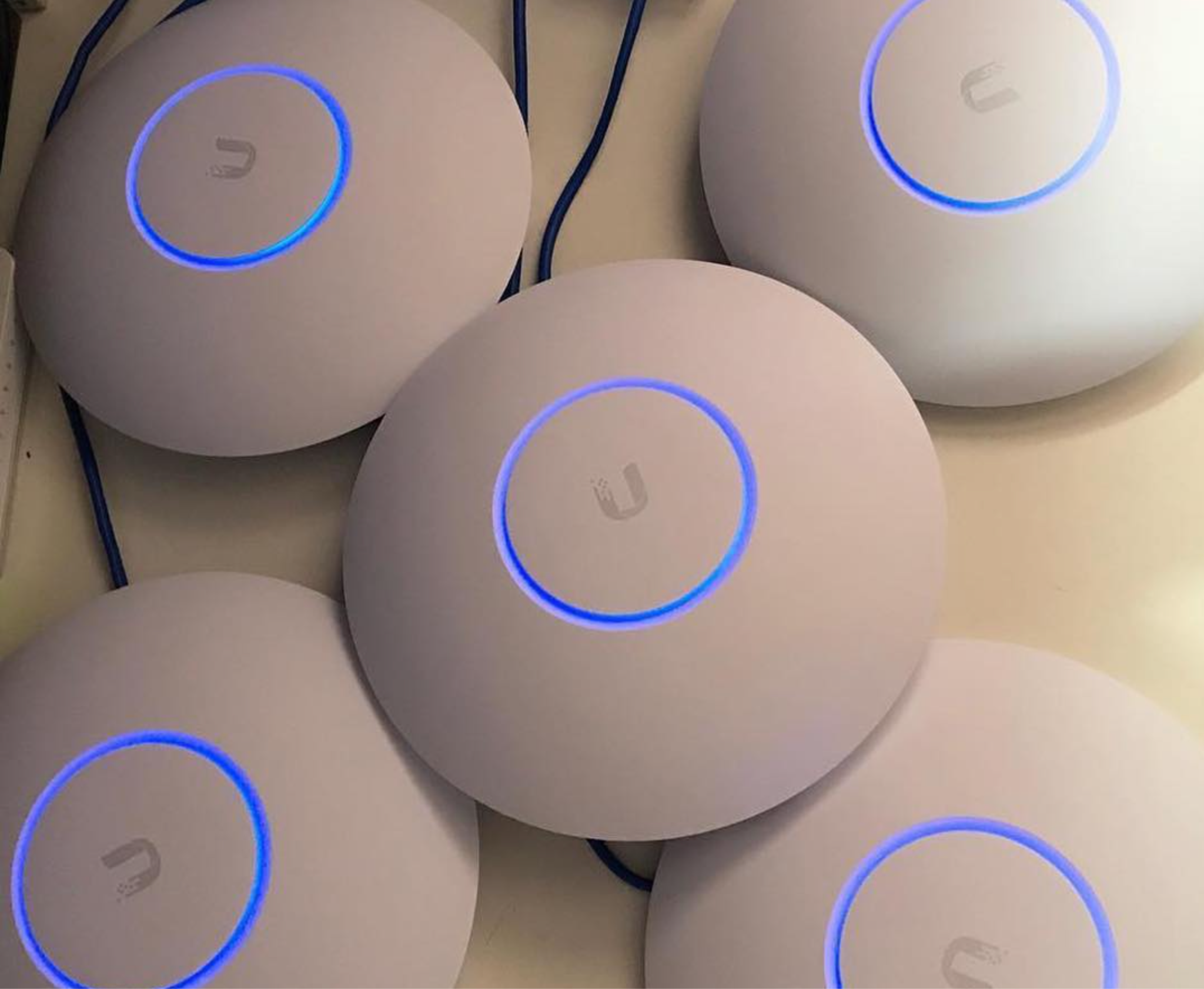
Not all access points are created equal.
UniFi WiFi systems are designed for demanding environments - from large homes to complex commercial buildings - and that experience shows.
UniFi manages how devices connect across the network, intelligently guiding them to the strongest available signal at any moment. Instead of clinging to weak connections, devices transition smoothly as you move around the space.
With the latest UniFi WiFi 7 technology, these systems are built to handle high device counts, legacy hardware and future demands - all while maintaining low latency and rock-solid reliability.
Some of the reasons we back UniFi include:
In short, UniFi systems are built to scale - wide and tall - without sacrificing stability.
One of the biggest mistakes we see is trying to solve WiFi issues by adding hardware without a plan.
More equipment doesn’t automatically mean better performance.
Smart WiFi design considers building layout and materials, usage patterns and device density, placement and power levels, and interference from surrounding networks.
When access points are planned properly, the result is a network that simply works - without constant troubleshooting or surprise upgrades later.
One of the reasons we love UniFi as a WiFi solution is its versatility.
For homeowners, it means consistent WiFi throughout the entire house, reliable coverage in garages, pool areas and guest spaces, and uninterrupted streaming and video calls.
For building managers and strata environments, it means stable networks across multiple levels, improved guest and tenant experiences, scalable infrastructure that grows with demand, and centralised control and visibility.
The same principles apply - just at different scales.
UniFi offers a versatile range of access points designed for different environments and requirements. The right choice depends on how the space is used, how many devices connect at once, and where coverage is needed most.
With centralised remote management, the network remains visible and manageable at scale - from large family homes and home offices through to strata-managed apartments, hotels and high-rise commercial buildings.
If WiFi is business-critical, guest-facing or central to how you live and work, it’s worth treating it like infrastructure - not an afterthought.
If you’re dealing with constant dropouts, planning a renovation, managing a multi-dwelling property or upgrading an Airbnb, professional design can save time, frustration and money long-term.
At DASH Symons, we approach WiFi the same way we approach all smart security and electrical systems - with clarity, transparency and foresight.
If your WiFi keeps dropping out, it’s rarely about speed or service providers.
More often, it’s about coverage.
Modern homes and buildings need more than one router. They need smart, well-designed access point systems that are built for how we actually live and work today.
With the right design in place, WiFi becomes something you stop thinking about - and start relying on.